
Employee training has become a critical part of business success. Organizations invest in training programs to improve employee skills, ensure compliance, and increase productivity. However, choosing the right training platform can be challenging. The most common comparison businesses face is TMS vs LMS.
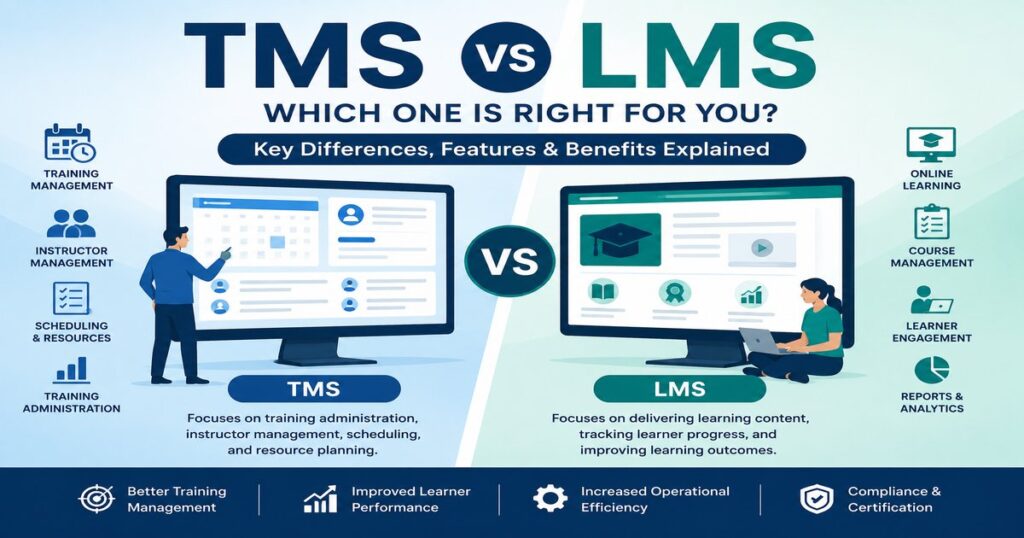
Although both systems support employee training and development, they serve different purposes. A Training Management System (TMS) focuses on planning, organizing, and managing training operations, while a Learning Management System (LMS) specializes in delivering digital learning experiences and tracking learner progress.
This guide explains the key differences between TMS and LMS, their benefits, use cases, and helps you decide which solution best fits your organization’s learning strategy.
Table of Contents
- What Is a Learning Management System (LMS)?
- What Is a Training Management System (TMS)?
- TMS vs LMS: Key Differences
- Benefits of Using an LMS
- Benefits of Using a TMS
- When Should You Choose an LMS?
- When Should You Choose a TMS?
- Can You Use Both Together?
- Frequently Asked Questions Conclusion
What Is a Learning Management System (LMS)?
A Learning Management System (LMS) is software designed to create, deliver, manage, and track online learning programs. It enables organizations to provide employees with self-paced training, onboarding programs, compliance courses, certifications, and professional development opportunities.
An LMS stores all learning content in one place, allowing learners to access courses anytime and from any device. Administrators can monitor course completion, learner progress, assessment scores, and generate detailed reports to measure training effectiveness.
Key Features of an LMS
- Online course creation and delivery
- Self-paced learning Learning
- progress tracking
- Assessments and quizzes
- Certifications
- Reporting and analytics
- Mobile learning support
- Integration with HR systems
What Is a Training Management System (TMS)?
An LMS is widely used by corporations, educational institutions, healthcare organizations, and training providers that prioritize digital learning.
Learn More…
A Training Management System (TMS) is software that helps organizations plan, organize, schedule, and manage training activities. Unlike an LMS, which focuses on learning delivery, a TMS focuses on the administrative and operational side of training.
A TMS simplifies tasks such as classroom scheduling, trainer management, registrations, venue management, attendance tracking, certification management, and resource allocation.
Organizations conducting instructor-led training or blended learning programs often rely on a TMS to streamline operations and improve efficiency.
Key Features of a TMS
- Training scheduling
- Instructor management
- Classroom and venue management
- Registration automation
- Attendance tracking
- Certification management
- Resource allocation
- Financial and administrative reporting
A TMS is commonly used by corporate training departments, educational institutions, certification providers, and training companies.
TMS vs LMS: Key Differences
| Feature | LMS | TMS |
|---|---|---|
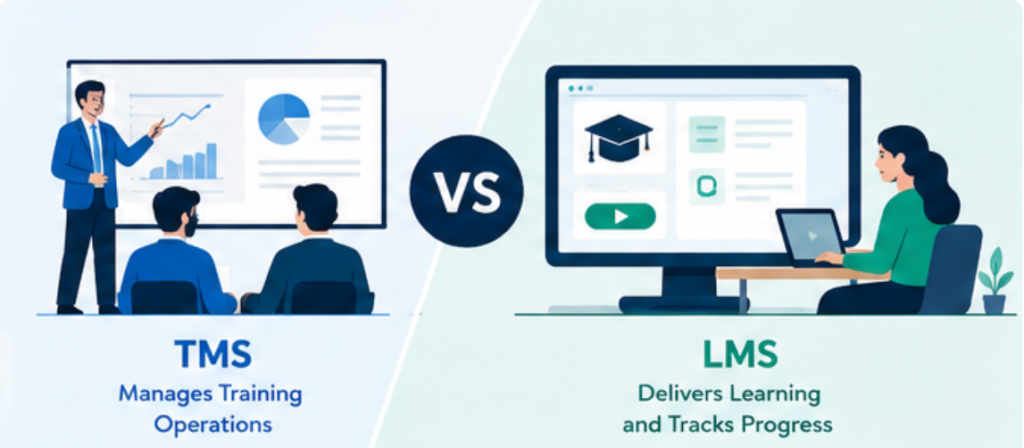
| Primary Purpose | Deliver online learning | Manage training operations |
| Course Delivery | ✔ Yes | Limited |
| Classroom Scheduling | ✘ No | ✔ Yes |
| Instructor Management | Basic | Advanced |
| Learner Tracking | Advanced | Basic |
| Resource Management | Limited | Advanced |
| Reporting & Analytics | Detailed learning reports | Operational reports |
| Best For | Online learning | Instructor-led training |
Benefits of Using an LMS
An LMS offers several advantages for organizations looking to improve learning experiences.
- Delivers online learning anytime and anywhere.
- Supports remote and hybrid workforce training.
- Tracks learner progress automatically.
- Improves employee engagement through interactive courses.
- Reduces training costs by replacing classroom sessions.
- Provides certifications and compliance tracking.
- Generates detailed performance reports.
- Supports continuous learning and skill development.

Businesses that prioritize digital learning often choose an LMS. because it offers flexibility, scalability, and improved learning outcomes.
Benefits of Using a TMS
A TMS helps organizations efficiently manage the administrative aspects of training.
Its major benefits include:
- Simplifies course scheduling.
- Manages instructors and trainers.
- Tracks attendance automatically.
- Organizes classroom resources.
- Handles registrations and enrollments.
- Supports certification management.
- Improves operational efficiency.
- Reduces manual administrative work
For organizations conducting frequent instructor-led training, a TMS saves significant time and improves overall training management.
When Should You Choose an LMS?
An LMS is the right choice if your organization wants to deliver digital learning programs.
Choose an LMS when you need:
- Employee onboarding
- Compliance training
- Online certification programs
- Remote workforce learning
- Skill development initiatives
- Self-paced learning
- Learning analytics
- Course management
Organizations with geographically distributed employees benefit greatly from LMS platforms because training can be accessed anytime and from any location.
When Should You Choose a TMS?
A TMS is more suitable for organizations that manage instructor-led training programs.
Choose a TMS if you need:
- Classroom scheduling
- Trainer management
- Venue management
- Resource allocation
- Attendance management
- Registration automation
- Certification administration
- Financial reporting
Training institutes, certification providers, and large enterprises often prefer a TMS because it streamlines complex administrative processes.
Read Also…
Can You Use Both Together?
Yes. Many organizations combine both systems to create a complete learning ecosystem.
A TMS manages the operational side of training, while an LMS delivers digital learning experiences.
Using both platforms together allows organizations to:
- Deliver online learning.
- Schedule classroom sessions.
- Manage trainers.
- Track learner progress.
- Improve reporting.
- Enhance employee development.
- Increase operational efficiency.
This combination offers the best of both worlds and is increasingly adopted by organizations with diverse training needs.
Frequently Asked Questions
What is the difference between TMS and LMS?
A TMS manages training administration, scheduling, instructors, and resources, whereas an LMS focuses on delivering online learning and tracking learner progress.
Which is better, TMS or LMS?
Neither is universally better. The right choice depends on your organization’s training requirements. LMS is ideal for digital learning, while TMS is better for managing instructor-led training.
Can TMS replace LMS?
No. A TMS manages training operations, while an LMS provides digital learning delivery. Many organizations integrate both systems for maximum efficiency.
Is LMS suitable for small businesses?
Yes. Modern cloud-based LMS platforms are affordable, scalable, and ideal for startups and small businesses looking to train employees efficiently.
Conclusion
Choosing between TMS vs LMS depends entirely on your organization’s training objectives, workforce, and learning strategy. If your primary goal is to deliver engaging online learning, track learner progress, and support continuous employee development, a Learning Management System (LMS) is the ideal solution. On the other hand, if your organization conducts instructor-led training and requires efficient scheduling, instructor management, attendance tracking, and resource planning, a Training Management System (TMS) is the better choice.
Many organizations achieve the best results by integrating both systems. A TMS streamlines training administration, while an LMS enhances the digital learning experience. Together, they create a comprehensive training ecosystem that improves operational efficiency, increases employee engagement, and supports long-term business growth.
Before making a decision, evaluate your organization’s training needs, budget, and future learning goals. Selecting the right platform today will help build a more skilled, productive, and future-ready workforce.